
Skill Maps
Skill Maps provide a curriculum-aligned view of phonics mastery across your class. Skills are organized according to your selected scope and sequence, making it easy to identify which skills students have mastered and which may need additional instruction.Accessing Skill Maps
1
Go to Skill Maps
From the teacher dashboard, click the Skill Maps tab.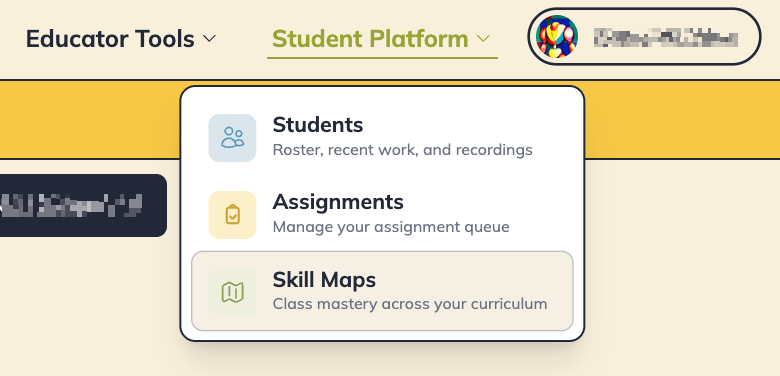
2
Review student mastery
Scan the class to identify patterns, compare student progress, and determine which phonics skills may need reteaching or additional practice.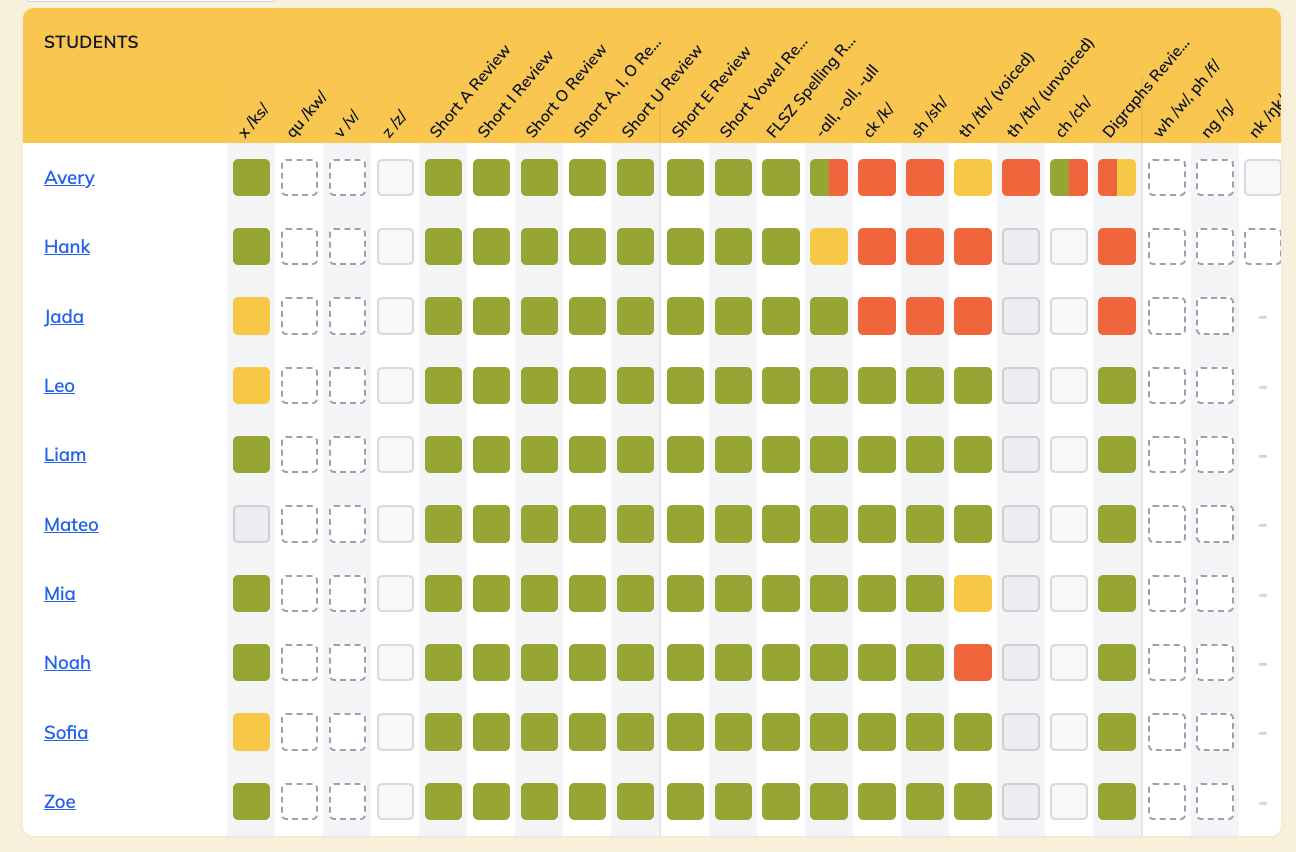
Skill Maps show progress mapped back to your selected, default scope and sequence.
- Monitor mastery across your phonics curriculum
- Identify class-wide trends and instructional gaps
- Plan small groups based on student needs
- Track growth as students complete additional practice
Full Student Reading History
Each student has a complete history of every reading session completed in LitLab, including fluency data and assignment activity. From a student’s reading history, you can review:- Completed stories, with their phonics skill and scope/sequence alignment
- Reading rate (WPM) and accuracy, including target-skill accuracy
- Comprehension results
- Correct and incorrect words
- The date each story was read
- Filter by skill to monitor growth over time
WPM is intentionally left blank (not shown as 0%) for readings where it couldn’t be reliably measured — Silent Reading assignments, for example, won’t have a WPM score.
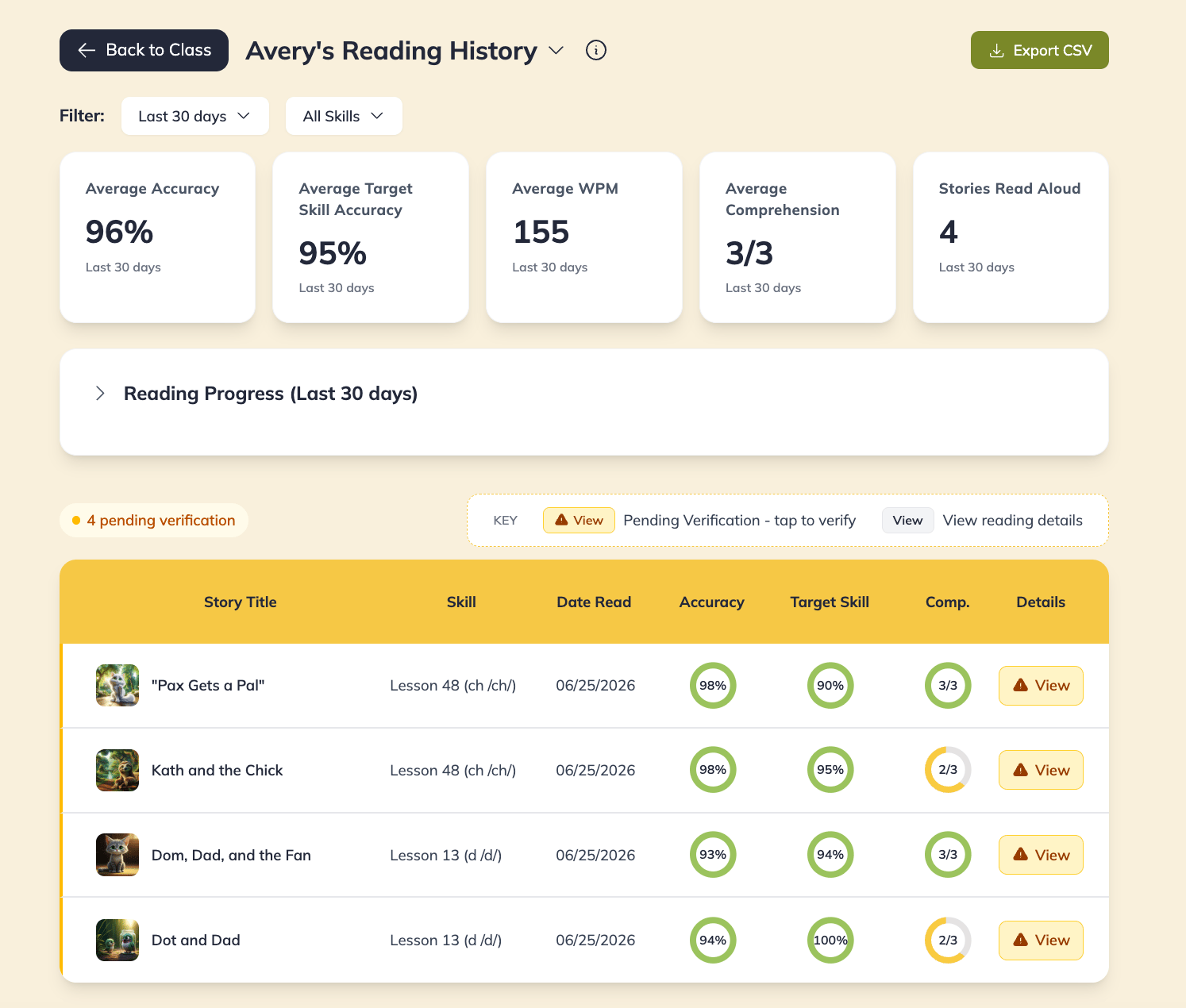
Accessing a student’s reading history
1
Open a student's profile
Click a student’s name from the teacher dashboard, or open their row and click View full history.
2
Review reading activity
Browse the student’s complete reading history to monitor progress over time and identify growth or areas needing support.
3
Export data
Export the student’s reading history as a CSV for additional analysis, documentation, or sharing with your school team.
- Monitoring intervention progress
- Preparing for MTSS, RTI, or parent conferences
- Reviewing long-term fluency growth
- Maintaining documentation of student reading performance
Export an individual student’s reading history
Need to share a student’s reading progress with a parent or keep a record for your own files? You can export a CSV of a single student’s Full Reading History — including the stories they’ve read, reading accuracy, incorrect words, and more — without exposing any other student’s data.1
Open the student's profile
From the Teacher Dashboard, click on the student’s name.
2
Filter (optional)
Narrow the results by date range or a specific phonics skill.
3
Export CSV
Click Export CSV to download that student’s reading history.
A single-student Skill Map export isn’t available yet. For parent-facing summaries, the Full Reading History CSV is the best way to share one student’s data without showing classmates’ information.
Learn more
- Teacher Dashboard — Monitor daily student activity and recent assignments.
- AI Fluency Analysis — Listen to student recordings and review AI-generated fluency insights.
- Managing Assignments — Track assignment completion and student progress.