
The golden rule: students should be explicitly taught a concept before they practice it independently in a LitLab text.
Whole-class instruction
Project or print one story and read it together to apply or review a concept everyone has been taught.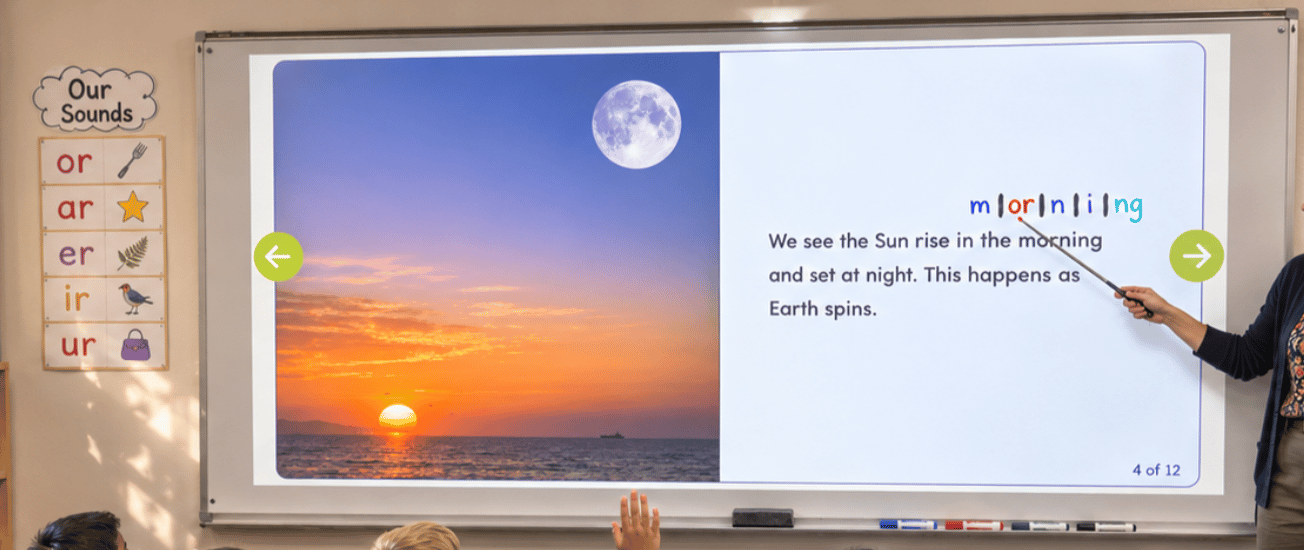
1
Start with your target skill
Choose the phonics skill you’re teaching from your scope and sequence.
2
Find a matching story
Pick a decodable that gives students plenty of practice with that skill. Preview it and plan a short response for after reading.
3
Put it on the big screen
Open the story, click View Full Screen, and project it onto your whiteboard. You can also print copies for each student.
4
Find and mark up target words
On pages with words that use the target skill, invite students up to the board to find a word and mark the letters that make the target sound. For example, when teaching R-controlled vowels, a student could highlight “or” in morning.
5
Give students a turn
Have individual students sound out a target word and blend it. Then reread the whole sentence together as a class.
- Reread on their own or with a partner
- Find more words with the target pattern
- Sequence events, or draw and write about an important part
- Answer a comprehension question
- Revisit the same story later in a center, including with Read Aloud
Reading centers
Centers give students extra practice with concepts they’ve already been taught, either the current concept or one you’ve chosen for review. Students should never meet a new phonics concept for the first time in an independent center. Before the rotation:- Choose the concept, story, and response activity.
- Keep the center routine familiar. Change the story or concept, not the activity.
- Make sure students know how to open the story, record if needed, finish the response, and ask for help.
- Prep devices, headphones, microphones, or printed copies.
Center options
- Read Aloud (digital)
- Printed practice
- Silent Reading (digital)
- Partner reading
Students complete the spelling activity, read aloud while each page is recorded, and answer comprehension questions. You get recordings and fluency data on your dashboard.Students need working microphones, a quiet-enough space, and explicit practice with recording. Limit how many students record at once based on your equipment and noise level. See Troubleshooting Student Recordings if recordings come through blank.
Small groups
In a teacher-led small group, you can explicitly teach or review a concept right before students apply it in a LitLab story. This is also where you can move a group beyond the class sequence when evidence shows they’re ready. Example rotation for one group:- Teacher-led review of the concept
- Read an aligned LitLab story together
- Reread with a partner or through Read Aloud mode
- Complete a short text-based response
Intervention
LitLab can supply the connected text portion of an intervention block:- Assessment and observation identify the need.
- You provide explicit instruction or reteaching.
- Students apply the concept in an aligned LitLab story, with supported reading and corrective feedback.
- You review their reading and decide the next step.
How often to use LitLab
We recommend two sessions a week, about 15 minutes each, in any routine.Review evidence and decide what’s next
What you can see depends on how students read:
You don’t need to review every data point. Try a weekly 15-minute routine: spend about 30 seconds listening to one recording per student. If you can’t get to everyone, start with surprising results and students who are struggling. Always listen to the recording before acting on the AI Fluency Analysis.